


Goat Production System: Purchasing Your Stocks
- Sep 9, 2015
- 6 min read
Updated: Sep 23, 2020

The success of your goat-based enterprise is hinged on the productivity of the animals, which, in turn, is dependent among others, on the type and kind of foundation stocks used.
This article discusses the physical, productive and reproductive attributes that your foundation stocks should possess. Likewise, it introduces the different breeds adapted to local conditions that you can use as breeder base.
1. Breeds Suited to Local Conditions
The following list of breeds will help you choose the foundation stocks that will meet your business objective.
Anglo Nubian (AN)
Anglo nubian goats are dual type meat-milk goats that can weigh about 75 kg
They possess facial stripes and graceful in appearance with long, wide and pendulous ears and convex Roman nose
AN in the Philippines are black, gray, cream, white, and shades of tan or reddish brown
They are adapted to tropical climate
Does produce 1.5-2kg of milk per day for a 250-day lactation period which is ideal for supporting the growth of kids


Boer
Boer goats are meat type goat that can weigh about 80kg
They are characterized by reddish brown head and neck and white body with short to medium hair and prominent horns
Does produce 0.75-1.25kg of milk for a 200-day lactation period

Weight (kg) of Full-blood Boer at different growth stages

Show Type Boer Doelings - Boer Goat Doe from Alaminos Goat Farm

Boer Goat at the Alaminos Goat Farm
Grades
Graded goats are offspring of either the two-way or three way crossing of the native strain and exotic breeds
They are taller and bigger than their native parents and vary in color depending on their parental and grandparental lines
Offspring from the first crossbreeding can weigh 30kg on the average while succeeding upgraded generations can weigh 10 kg more than the first set of offspring
Does can give only 0.7-1.0 kg of milk for 215 days of lactation

Result of Crossing the Australian Saanen Doe and American Saanen Buck, Good Looking Saanen Kids
Native Strain
Native strains are the local strains that are small and stocky
These are reddish-brown, white, black or a combination of these colors
They are hardy and are known to subsist even in harsh environments, where available fodder cannot support cattle during the dry season
Does can give 0.3kg milk for 187-day lactation period

2. Choosing Your Foundation Stocks
When establishing a goat enterprise for the first time, purchase an economic size herd of 25 females of the native or graded strains.
Start with native or graded stocks if you are a new entrant in the goat business. This will entail lesser risks on your part.
Starting with this kind of goats is advantageous, as less investment is involved and the goats are adapted to local conditions already
If you cannot buy all 25 females from just one farm, purchase from several farms. Sourcing 25 females from one farm may be difficult hence purchase from several farms.
For the male breeder, purchase either a pure exotic breed or a graded strain with 75% exotic bloodline
Purchase 1 buck for every 25 females
Examining the Animals
Thoroughly inspect the animals before purchasing them, to avoid getting inferior stocks
Check not just the physical features but ask the seller about the productive and reproductive performance of the goats
If performance data is available, choose stocks based on the following:
number of offspring weaned per doe per year (it is a good stock if it comes from a herd with 4.5 kids weaned in 2 years)
mortality for each sex (it is a good stock if it comes from a herd with 10% or less mortality for preweaners)
length of productive life of grandparents / parents (the grand parents must have lived for at least 5 years)
incidences of major defects (no history of major defects within the herd)
Get your foundation stocks from reliable and reputable sources. See the list below of government nucleus and multiplier farms for goats in your area where you can purchase your foundation stocks
Directory of Nucleus and Multiplier Farms for Goats

You can also contact the heads of the small ruminant raisers group in your region for possible private farms who sell quality stocks, gadgets and forages.
Upon purchase, quarantine the goats for a month. Confine the newly purchased goats in one area of the farm for one month and do not allow them to graze outside. In this way they can be observed closely and the needed remedial measure administered immediately.
Deworming your stocks
Ideally, you should collect fecal samples from these newly purchased goats and submit to a diagnostic animal laboratory to see if there is a need for deworming.
To be safe however, deworm the goats at source or at the farm where you purchased them.
If this is not possible, drench them two weeks after arrival in your farm with a broad spectrum dewormer.
If you do not have any experience in deworming animals, either call a veterinarian or follow these simple steps:
Simple guide to deworming
1. Prior to deworming, withhold feed for a day. If the animals are to be dewormed in the morning, do not allow them to graze for 12hrs. Give ample amount of water though.
2. Weigh each animal and calculate the amount of dewormer based on weight. Follow the recommended dosage in the label. Remember that estimating the weight usually leads to underdosing.
3. Where weighing of individual animal is impractical, just weigh the heaviest mature goat within each management group (eg. breeders, growers) and let this represent the average weight of the group.
4. For oral deworming, you can use a plastic syringe without the needle to measure the drug. These are available in most drug stores. If a drenching gun is available, use it.
When the amount of drench is determined, position the goat between your knees to keep it still.
5. Carefully place the syringe at the side of the cheek near the base of the tongue. This will ensure the deposition of the dewormer into the first compartment of the goat's stomach. Drench delivered at the front of the mouth usually reaches the fourth compartment and becomes less effective.
6. If deworming is done in the morning, release the animal in the pasture or give feed in the stall in the afternoon. This will allow the dewormer to take its effect before any feed can affect its action.
3. Selecting a Good female Breeder
Selecting a Good Female Breeder
Regardless of breed, select breeder females free of physical defects, with the following attributes:
Healthy with no deformities
Good body conformation
Large body size, not less than 30 kg in weight at 6-8 months of age
Strong and straight fore and hind legs
Clean and shiny haircoat
Normal genitals
Good udder appearance
big and well attached udders
smooth, firm, balanced in shape, and hanging in uniform length
with teats large enough for milking
Good mothering ability with history of being protective and caring for her young
Good temperament, docile and easy to handle
Good pedigree, coming from an excellent milk producing dam
Selecting a good male breeder
Look for the following attributes in the male breeding stock that you will purchase:
Healthy with no deformities
With clean and shiny haircoat
Large body size and heaviest in the herd, not less than 40kg in weight
Good body conformation
well developed chest and body
fairly straight back
long and elevated hind quarters and straight and strong legs
Good sex organs
large, firm testicles equal in size and well let down
penis with no kinks or abnormalities
At least 8-12 months old if to be used for immediate breeding
From good bloodline
From does with high percentage of twinning
Aggressive, active and always ready to mount a female in heat
4. Identifying Goat Defects
At all cost, avoid purchasing animals with the following characteristics
Overshot and undershot jaws
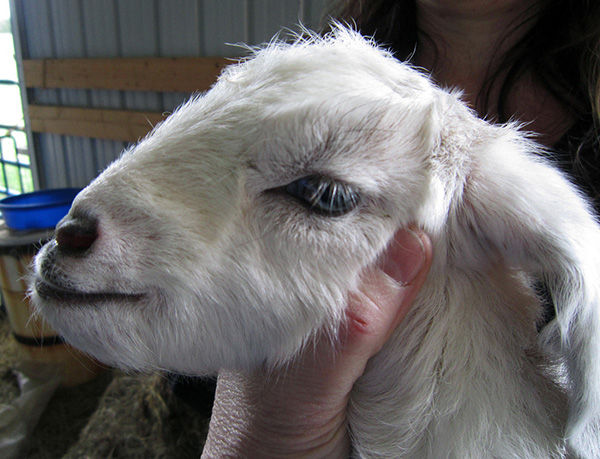
Undershot Jaw

Overshot Jaw
Extra teats

Split testicles

Twisted and folded ears

Abnormal horn

Poor maternal instinct
Deformed hooves
Abnormal and weak legs
From parental lines of poor milkers
Related Articles:
Comments